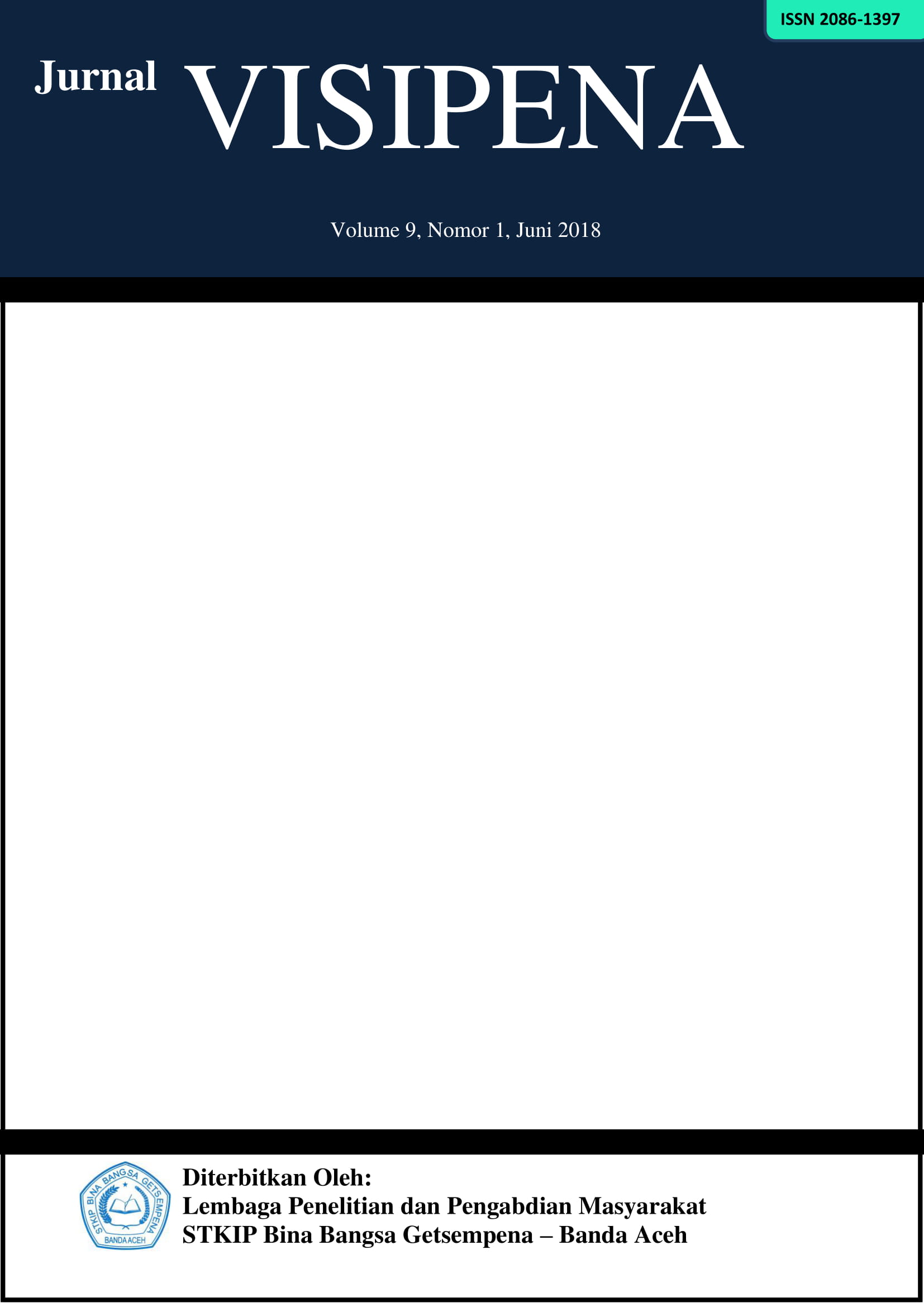
HUBUNGAN ANTARA KEAKTIFAN BELAJAR SISWA TERHADAP KEMAMPUAN KOMUNIKASI MATEMATIS SISWA SMK
DOI:
https://doi.org/10.46244/visipena.v9i1.448Keywords:
Activity Learning, Mathematical Communication SkillAbstract
The main purpose of this study is to see the relationship between the learning activities on the communication skills of vocational students. Quantitative research and correlational data analysis takes the population of all students of SMK Negeri 1 Cipanas - Cianjur. The samples used were non-random samples, ie 21 students of class XI TKJ 2 in SMK Negeri 1 Cipanas - Cianjur. The tool used for data collection is a matter of mathematical communication ability and questionnaire of student learning activeness. Data analysis technique used is correlation test with data criteria are normal and linear distributed. Based on the results of research, it can be concluded that the relationship between students 'learning activities to students' mathematical communication skills. The influence of the contribution given by students' learning activity toward mathematical communication is 70,02%.
Abstrak
Tujuan utama dari penelitian ini adalah untuk melihat hubungan antara keaktifan belajar terhadap kemampuan komunikasi siswa SMK. Penelitian kuantitatif dan analisis data korelasional ini mengambil populasi seluruh siswa SMK Negeri 1 Cipanas - Cianjur. Adapun sampel yang digunakan adalah sampel tak acak, yaitu 21 orang siswa kelas XI TKJ 2 di SMK Negeri 1 Cipanas - Cianjur. Alat yang digunakan untuk pengumpulan data berupa soal kemampuan komunikasi matematis dan angket keaktifan belajar siswa. Teknik analisis data yang digunakan adalah uji korelasi dengan kriteria data tersebut berdistribusi normal dan linier. Berdasarkan hasil penelitian, dapat disimpulkan bahwa adanya hubungan antara keaktifan belajar siswa terhadap kemampuan komunikasi matematis siswa. Besar pengaruh kontribusi yang diberikan keaktifan belajar siswa terhadap komunikasi matematis sebesar 70,02%.
Kata Kunci : Keaktifan Belajar, Kemampuan Komunikasi Matematis
Downloads
References
Endahwuri, D. (2015). “Pengembangan Bahan Ajar Berbasis Guided Inquiry untuk Meningkatkan Kemampuan Komunikasi Siswa”. AKSIOMA: Jurnal Pendidikan Matematika Universitas PGRI Semarang. Vol.6, No. 1. ISSN 2579-7646
Firdawati, I., dan Rohmah, M, S. (2017). “Analisis Kemampuan Komunikasi Matematis Siswa Kelas XI Sekolah Menengah Kejuruan (SMK) Negeri 1 Cipanas Pada Materi Baris dan Deret”. Prosiding Seminar Nasional Matematika dan Pendidikan Matematika STKIP Siliwangi Bandung. Vol.5. (633-641). ISSN 2338-8315
Hendriana, H., Rohaeti, E. E., & Sumarmo, U. (2017). Hard Skills dan Soft Skills. Bandung: Refika Aditama.
Ramlah., Firmansyah, D., Zubair, H. (2014). “Pengaruh Gaya Belajar dan Keaktifan Siswa Terhadap Prestasi Belajar Matematika (Survey pada SMP Negeri di Kecamatan Klari Kabupaten Karawang)”. Jurnal Ilmiah Solusi Vol.1 No.3 (68-75)
Riduwan.(2010). Dasar-Dasar Statistika. Bandung : ALFABETA
Ruseffendi, H. E. T. (1993). Statistika Dasar Untuk Penelitian Pendidikan. Bandung: Depdikti
Wahid, U. (2012). “Membangun Kemampuan Komunikasi Matematis dalam Pembelajaran Matematika”. Infinity Jurnal Ilmiah Program Studi Matematika STKIP Siliwangi Bandung. Vol.1 No. 1
Downloads
Published
How to Cite
Issue
Section
License
Authors who publish with this journal agree to the following terms:
- Authors retain copyright and grant the journal right of first publication with the work simultaneously licensed under a Creative Commons Attribution License that allows others to share the work with an acknowledgment of the work's authorship and initial publication in this journal.
- Authors are able to enter into separate, additional contractual arrangements for the non-exclusive distribution of the journal's published version of the work (e.g., post it to an institutional repository or publish it in a book), with an acknowledgment of its initial publication in this journal.
- Authors are permitted and encouraged to post their work online (e.g., in institutional repositories or on their website) prior to and during the submission process, as it can lead to productive exchanges, as well as earlier and greater citation of published work (See The Effect of Open Access).






1_(1)1.png)