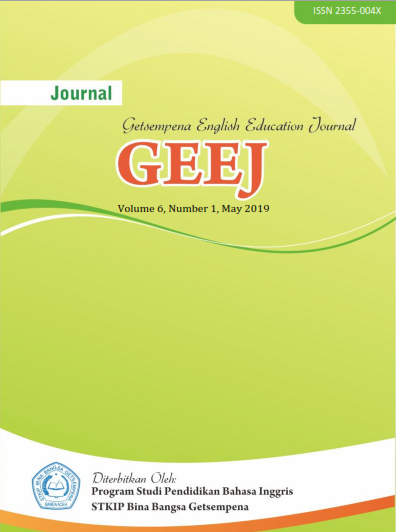
THE ACQUISITION OF PARAPHRASING AND ITS IMPACT ON TEACHING AND LEARNING QUOTATIONS TO AVOID PLAGIARISM
DOI:
https://doi.org/10.46244/geej.v6i1.873Keywords:
the acquisition of paraphrase, teaching and learning quotation, avoiding plagiarismAbstract
Paraphrase is the one way to avoid plagiarism beside quotation. Paraphrase means using someone idea or thought as the references but in our own meaning without lost the meaning while quotation means using someone idea or thought without change anything. Paraphrase or quotation is an important things to teach to the students, especially for university students who learning about writing and have to mastered the writing skill. Unfortunately, not all of students know the correct way to do paraphrase so they can be labeled as plagiarist. From this problem, this study wants to provide several analysis of literature review about the acquisition of paraphrasing, teaching and learning quotations to avoid plagiarism, and also its impact on teaching and learning. The result of this study are the concepts of paraphrasing acquisition, impacts on teaching and learning quotations, and some suggestion or ways in avoiding plagiarism.
References
Benucci, H. (2012). Using Evidence in Academic Writing: Avoiding Plagiarism. Towson University Academic Integrity Policy. Retrieved August 11, 2018, from https://americanenglish.state.gov/files/ae/resource_files/using_evidence_in_academic_writing.pdf
Bhagat, R., & Ravichandran, D. (2008, June). Large Scale Acquisition of Paraphrases for Learning Surface Patterns. In ACL (Vol. 8, pp. 674-682).
Bouamor, H., Max; A., Illouz, G., &Vilnat, A. (2012). A Contrastive Review of Paraphrase Acquisition Techniques Proceedings of the Eight International Conferences on Language Resources and Evaluation (LREC'12).Retrieved December 31, 2016, from http://www.lrecconf.org/proceedings/lrec2012/pdf/555_Paper.pdf
Burrows, S., Potthast, M., & Stein, B. (2013).Paraphrase Acquisition Via Crowd sourcing And Machine Learning. ACM Transactions on Intelligent Systems and Technology (TIST), 4(3), 43.
Ganitkevitsch, J. (2013). Retrieved August 11, 2018, from
https://www.cs.jhu.edu/~juri/pdf/proposal-naacl-2013-srw.pdf
General Information about Mla Parenthetical Citations. (2008). Retrieved December 31, 2016, from
http://writing.wisc.edu/Handbook/DocMLACitation_Info.html
Jordan, R. (2003). Academic Writing Course (3rd ed., Vol. 1). Charlbury, Oxfordshire: Bluestone Press.
Krause, S. (2007). Quoting, Paraphrasing, and Avoiding Plagiarism. In The Process of Research Writing. Retrieved December 31, 2016, from
http://www.stevendkrause.com/tprw
Pecorari, D. (2010). Academic Writing and Plagiarism (2nd ed., Vol. 1). London: Continuum International Publishing Group.
Scanlon, P. M., & Neumann, D. R. (2002). Internet Plagiarism Among College Students. Journal of College Student Development, 43(3), 374-385.
A Quick Orientation to APA. (n.d.). Retrieved December 31, 2016, from
http://writing.wisc.edu/Handbook/DocAPAOrientation.html
Summarizing, Paraphrasing, and Quoting. (n.d.). Retrieved December 31, 2016, from http://isites.harvard.edu/icb/icb.do?keyword=k70847&pageid=icb.page350378
Summarizing, Paraphrasing, and Quoting by Trent University. (n.d.). Retrieved December 31, 2016, from
https://www.trentu.ca/history/workbook/summarizingparaphrasingandquoting.php#b
What Is Quoting? (n.d.). Retrieved December 31, 2016, from
http://www.plagiarism.org/citing-sources/quoting-material/
Downloads
Published
How to Cite
Issue
Section
License
All works published in the Getsempena English Education Journal (GEEJ) are licensed & copyrighted under a Creative Commons Attribution-NonCommercial 4.0 International License. The editorial board of the GEEJ shares common vision with Universitas Bina Bangsa Getsempena as a Publisher in providing unrestricted access to knowledge and education for all and thereby follows Open Access Policy to showcase its content. The GEEJ follows open access copyright and licensing policy on the principle that making research freely available to the public supports a greater global exchange of knowledge.
Universitas Bina Bangsa Getsempena and the GEEJ adhere to a Creative Commons Attribution-NonCommercial 4.0 International License. The authors submitting and publishing in the GEEJ agree to the copyright policy under a Creative Commons Attribution-NonCommercial 4.0 International License. Under this license, the authors published in the GEEJ retain the copyright, and all other authors using the content of the GEEJ are required to cite author(s) and publisher in their work.