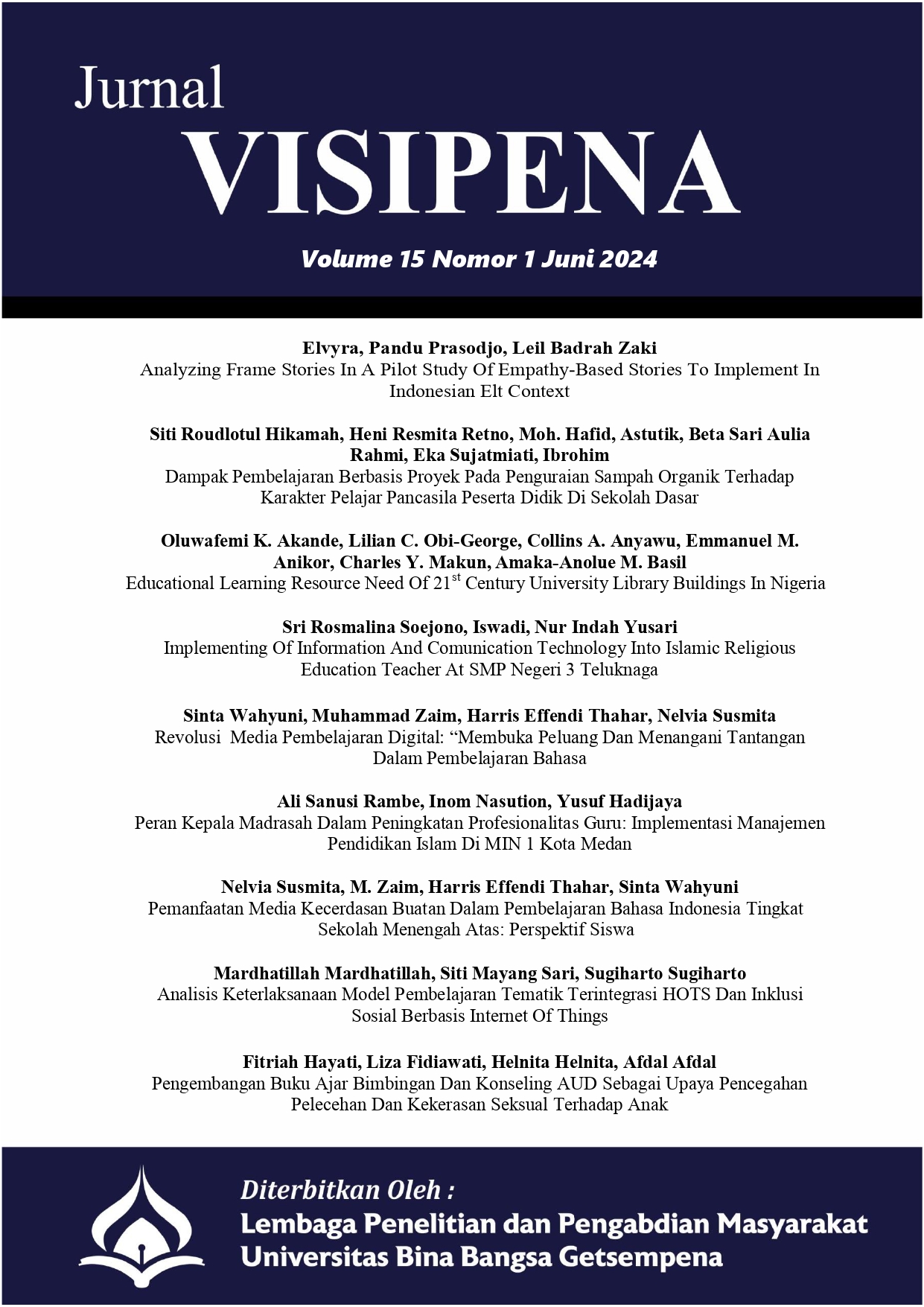
THE ROLE OF SPEAKING SKILLS IN IMPROVING STUDENTS' SELF-CONFIDENCE AND COMMUNICATION ABILITIES
Keywords:
Speaking Skills, Self-Confidence, Communication Skills, StudentsAbstract
Speaking skills are an essential competency for students to support successful communication in both academic and professional settings. However, many students still experience challenges such as lack of confidence, anxiety, and difficulty conveying ideas in public. This study aims to analyze the role of speaking skills in improving students' self-confidence and communication skills. The method used was descriptive quantitative research, with questionnaires distributed to students and supported by relevant literature studies. The results showed a positive relationship between speaking skills and increased student self-confidence. Students who actively participated in presentations, group discussions, and organizational activities had better articulation skills, structuring ideas, and managing speaking anxiety. Thus, speaking skills play a crucial role in building self-confidence and effective communication. Universities need to provide more practical activities to continuously develop students' speaking skills.
Downloads
References
Bandura, A. (1977). Self-efficacy: toward a unifying theory of behavioral change. Psychological review, 84(2), 191-215. https://doi.org/10.1037/0033-295X.84.2.191
Horwitz, E. K., Horwitz, M. B., & Cope, J. (1986). Foreign language classroom anxiety. The Modern language journal, 70(2), 125-132. https://doi.org/10.1111/j.1540-4781.1986.tb05256.x
MacIntyre, P. D., & Gardner, R. C. (1994). The subtle effects of language anxiety on cognitive processing in the second language. Language Learning, 44(2), 283-305. https://doi.org/10.1111/j.1467-1770.1994.tb01103.x
Marinho, A. C. F., de Medeiros, A. M., Gama, A. C. C., & Teixeira, L. C. (2017). Fear of public speaking: Perception of college students and correlates. Journal of Voice, 31(1), 127.e7-127.e11. https://doi.org/10.1016/j.jvoice.2015.12.012
McCroskey, J. C. (1977). Oral communication apprehension: A summary of recent theory and research. Human Communication Research, 4(1), 78-96. https://doi.org/10.1111/j.1468-2958.1977.tb00599.x
McCroskey, J. C. (1982). Oral communication apprehension: A reconceptualization. Communication Yearbook, 6, 136-170. https://doi.org/10.1080/23808985.1982.11678497
McCroskey, J. C., & McCroskey, L. L. (1988). Self-report as an approach to measuring communication competence. Communication Research Reports, 5(2), 108-113. https://doi.org/10.1080/08824098809359810
Megawati, M., & Apriani, T. (2023). The dynamics of public speaking anxiety and its impact on speaking performance: A study among college students in business and economics. Jurnal Ilmiah Manajemen Kesatuan, 11(3), 1453-1462. https://doi.org/10.37641/jimkes.v11i3.2156
Miskam, N. N., & Saidalvi, A. (2019). Investigating English language speaking anxiety among Malaysian undergraduate learners. Asian Social Science, 15(1), 1-7. https://doi.org/10.5539/ass.v15n1p1
Mohtasham, L., & Farnia, M. (2017). English speaking anxiety: A study of the effect of gender on Iranian EFL university students' perceptions. International Journal of Research in English Education, 2(4), 66-79. https://doi.org/10.29252/ijree.2.4.66
Mora, J. C., Mora-Plaza, I., & Bermejo Miranda, G. (2024). Speaking anxiety and task complexity effects on second language speech. International Journal of Applied Linguistics, 34(1), 292-315. https://doi.org/10.1111/ijal.12494
Mouhoubi-Messadh, C., & Khaldi, K. (2022). Dealing with foreign language speaking anxiety: What every language teacher should know. Training, Language and Culture, 6(1), 20-32. https://doi.org/10.22363/2521-442X-2022-6-1-20-32
Muslem, A., Fata, I. A., & Inayatullah, I. (2019). Factors affecting internship students' speaking anxiety. Al-Ta Lim Journal, 26(2), 204-212. https://doi.org/10.15548/jt.v26i2.531
Nasution, F. S., & Nissa, K. (2024). Investigating student's level of self-efficacy in speaking performance of Thai EFL learners. Esteem Journal of English Education Study Programme, 7(2). https://doi.org/10.31851/esteem.v7i2.14966
Pontillas, M., & Talaue, F. (2021). Levels of oral communication skills and speaking anxiety of educators in a polytechnic college in the Philippines. Journal of Education, Management and Development Studies, 1(1), 24-32. https://doi.org/10.52631/jemds.v1i1.15
Putri, H., Sujadi, E., & Ahmad, B. (2024). Kecemasan berbicara di depan umum pada mahasiswa: Apakah efikasi diri memiliki peran?. Journal of Education, Humaniora and Social Sciences, 7(1), 25-33. https://doi.org/10.34007/jehss.v7i1.2229
Rahmi, R., & Raihana, I. (2025). Sources of self-efficacy influencing English speaking skills of EFL learners. ELT Echo: The Journal of English Language Teaching in Foreign Language Context, 10(1). https://doi.org/10.24235/eltecho.v10i1.19500
Setiadi, H. (2025). Pengaruh kecemasan berbicara (speaking anxiety) terhadap kemampuan public speaking dengan self-confidence sebagai variabel mediasi pada mahasiswa perguruan tinggi vokasi. Jurnal Education and Development, 13(1), 861-866. https://doi.org/10.37081/ed.v13i1.7360
Woodrow, L. (2006). Anxiety and speaking English as a second language. RELC Journal, 37(3), 308-328. https://doi.org/10.1177/0033688206071315
Yoskapela, Y., Susanty, S., Bahing, B., & Ristati, R. (2022). A study on speaking anxiety of English Education Study Program students at the University of Palangka Raya. EBONY: Journal of English Language Teaching, Linguistics, and Literature, 2(1), 14-27. https://doi.org/10.37304/ebony.v2i1.4065
Downloads
Published
How to Cite
Issue
Section
License
Copyright (c) 2024 Teuku Mahmud, Hendra Kasmi, Yusrawati JR Simatupang, Ela Montia, Armadan Armadan

This work is licensed under a Creative Commons Attribution-NonCommercial 4.0 International License.
Authors who publish with this journal agree to the following terms:
- Authors retain copyright and grant the journal right of first publication with the work simultaneously licensed under a Creative Commons Attribution License that allows others to share the work with an acknowledgment of the work's authorship and initial publication in this journal.
- Authors are able to enter into separate, additional contractual arrangements for the non-exclusive distribution of the journal's published version of the work (e.g., post it to an institutional repository or publish it in a book), with an acknowledgment of its initial publication in this journal.
- Authors are permitted and encouraged to post their work online (e.g., in institutional repositories or on their website) prior to and during the submission process, as it can lead to productive exchanges, as well as earlier and greater citation of published work (See The Effect of Open Access).







1_(1)1.png)