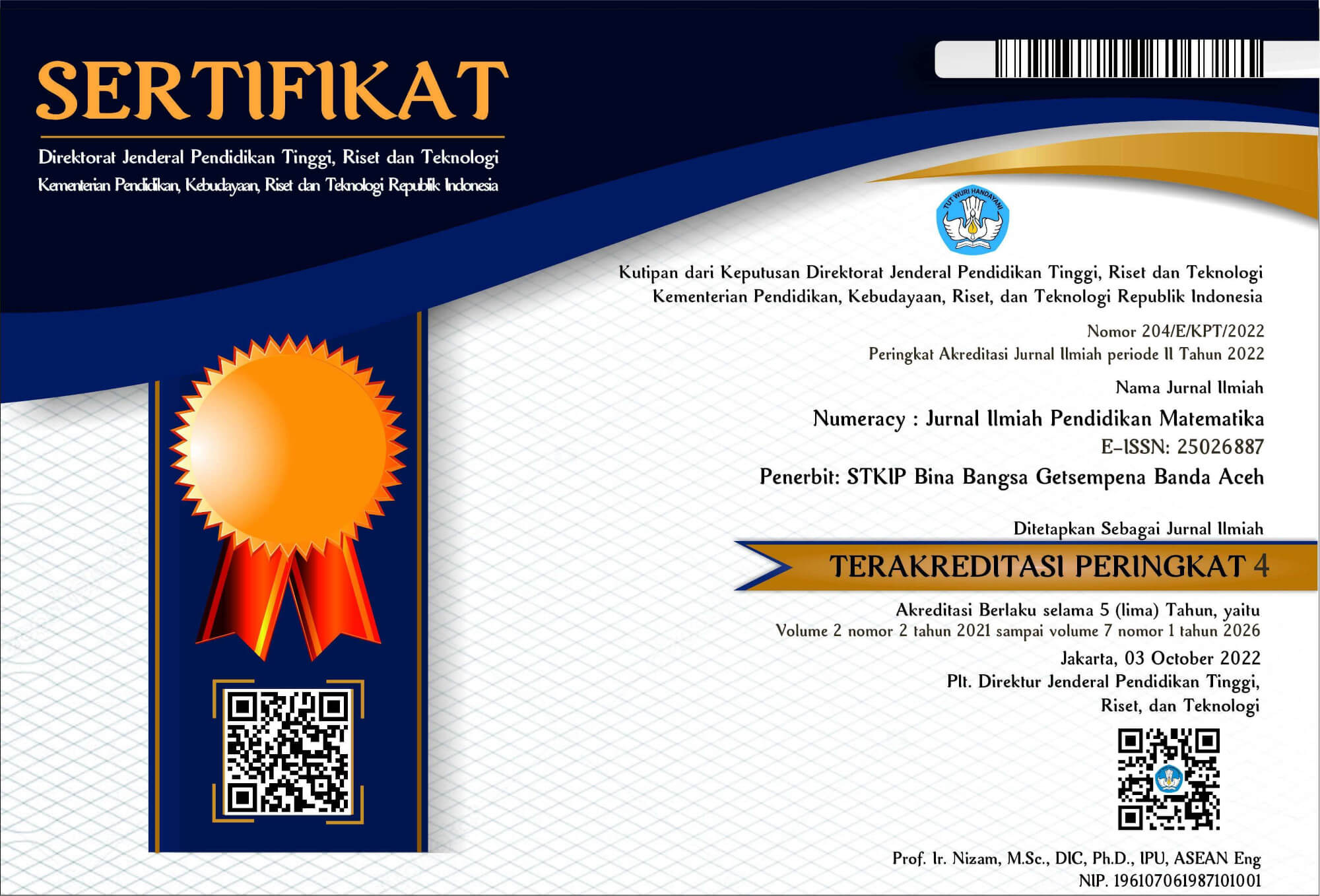
SINTA & ISSN CERTIFICATES
Author Guidelines
Numeracy Journal accepts original research articles, systematic reviews, and theoretical or conceptual papers that have not been previously published nor are under consideration for publication elsewhere. Manuscripts must be written in clear, coherent, and academically rigorous English, adhering to international scholarly standards. Submissions should align with the journal’s focus on cultural, technological, and Global South perspectives in mathematics education. Authors are expected to demonstrate originality, articulate a clear contribution to the field, employ a robust theoretical foundation, and apply rigorous and appropriate research methodologies. Manuscripts should be relevant to an international audience and contribute meaningfully to ongoing academic discourse in mathematics education.
- Manuscript Structure (IMRAD Format)
Manuscripts must be organized according to an extended IMRAD structure to ensure clarity, coherence, and academic rigor. The title should be concise, informative, and reflective of the study’s primary contribution. The abstract (150–250 words) must summarize the research background, objectives, methodology, key findings, and implications, followed by 3–5 relevant keywords. The introduction should clearly present the research problem, identify gaps in the international literature, and outline the objectives and contributions of the study. The theoretical framework must establish the conceptual or theoretical basis guiding the research. The methodology section should provide a transparent and detailed account of the research design, participants, instruments, data collection procedures, and analytical methods. The results should be presented systematically with appropriate use of tables or figures, emphasizing analytical depth rather than mere description. The discussion must interpret the findings in relation to the theoretical framework and relevant international studies, highlighting their significance and originality. The implications section should articulate both theoretical and practical contributions, while the conclusion should succinctly summarize the key findings without redundancy. References must follow a consistent citation style and prioritize recent, high-quality international sources. - Language and Writing Quality
Manuscripts must be written in high-quality academic English, demonstrating clarity, coherence, and logical organization. Authors are expected to employ a formal scholarly tone, present arguments systematically, and support claims with appropriate evidence and references. Excessive descriptive writing without analytical depth should be avoided. Authors whose first language is not English are strongly encouraged to seek professional language editing services prior to submission. Manuscripts with significant grammatical errors, unclear structure, or poor readability may be rejected before entering the peer review process. - Ethical Standards
Authors must adhere strictly to the journal’s publication ethics and integrity policies. All submissions must be original, properly cited, and free from plagiarism, including self-plagiarism and redundant publication. Manuscripts must not be under consideration by any other journal at the time of submission. Authors are responsible for ensuring the accuracy and authenticity of their data and must avoid any form of data fabrication or falsification. Research involving human participants must comply with ethical standards, including informed consent and confidentiality. Any potential conflicts of interest must be disclosed at the time of submission. - Article Types
The journal accepts a range of scholarly contributions, including empirical research articles employing quantitative, qualitative, or mixed methods; systematic literature reviews conducted using transparent and rigorous methodologies (e.g., PRISMA); and theoretical or conceptual papers that advance knowledge in the field. Submissions that are purely descriptive, such as classroom action research without substantial theoretical contribution or broader implications, are not prioritized unless they demonstrate strong methodological rigor and clear relevance to international discourse. - Submission Process
All manuscripts must be submitted through the journal’s official online submission system. Authors are required to provide complete and accurate metadata, including author information, affiliations, abstract, and keywords, and to upload all necessary files, including the main manuscript and any supplementary materials. Submissions must conform to the journal’s formatting and structural requirements. Manuscripts that do not adhere to these guidelines may be returned to the authors or rejected during the initial screening stage. - Final Notes
Authors are strongly encouraged to ensure that their submissions clearly articulate a research gap, demonstrate international relevance, and provide both theoretical and practical contributions to the field of mathematics education. Manuscripts should be grounded in a robust theoretical framework and supported by rigorous methodology and analysis. Submissions that fail to meet these standards or lack broader academic significance may be rejected. Adherence to these guidelines will support the journal’s mission to publish high-quality, impactful research that contributes to global scholarship.

.png)