SUBMISSION PREPARATION




Numeracy Journal is committed to maintaining the highest standards of academic integrity and originality in scholarly publishing. All submitted manuscripts must be the original work of the authors and must not contain any form of plagiarism, including but not limited to direct copying, paraphrasing without proper citation, self-plagiarism, data fabrication, or redundant publication.
To ensure originality, all manuscripts are screened using plagiarism detection software such as Turnitin prior to the peer review process. The journal applies a strict similarity threshold policy as follows: manuscripts with a total similarity index exceeding 20% will be subject to rejection or returned to the authors for revision, while any single-source similarity exceeding 5% without proper citation will be considered unacceptable. Similarity arising from properly cited references, standard methodological descriptions, or commonly used phrases may be excluded from evaluation at the discretion of the editorial team.
Authors are required to properly cite and acknowledge all sources of information, including previously published work, and to ensure that all quotations are clearly indicated. Reuse of the authors’ own previously published work (self-plagiarism) must be appropriately cited and justified, and excessive overlap with prior publications will not be tolerated. Manuscripts derived from theses, dissertations, or conference proceedings must be substantially revised and clearly disclosed at the time of submission.
The journal strictly prohibits duplicate submission and redundant publication. Authors must confirm that their manuscript is not under consideration by any other journal. Any attempt to submit the same or substantially similar work to multiple journals simultaneously will be considered a serious ethical violation.
If plagiarism or ethical misconduct is detected at any stage of the publication process—whether before or after publication—the editorial board will take appropriate action in accordance with international publication ethics standards. These actions may include manuscript rejection, request for revision, withdrawal of the article, publication of corrections or retractions, and notification to the authors’ affiliated institutions.
Reviewers and editors are also expected to remain vigilant in identifying potential plagiarism and ethical issues. The journal reserves the right to re-screen accepted manuscripts prior to publication to ensure compliance with its originality standards. By submitting a manuscript to Numeracy, authors agree to comply with this plagiarism and similarity policy and to uphold the principles of ethical academic publishing.
SUBMISSION PREPARATION
SINTA & ISSN CERTIFICATES
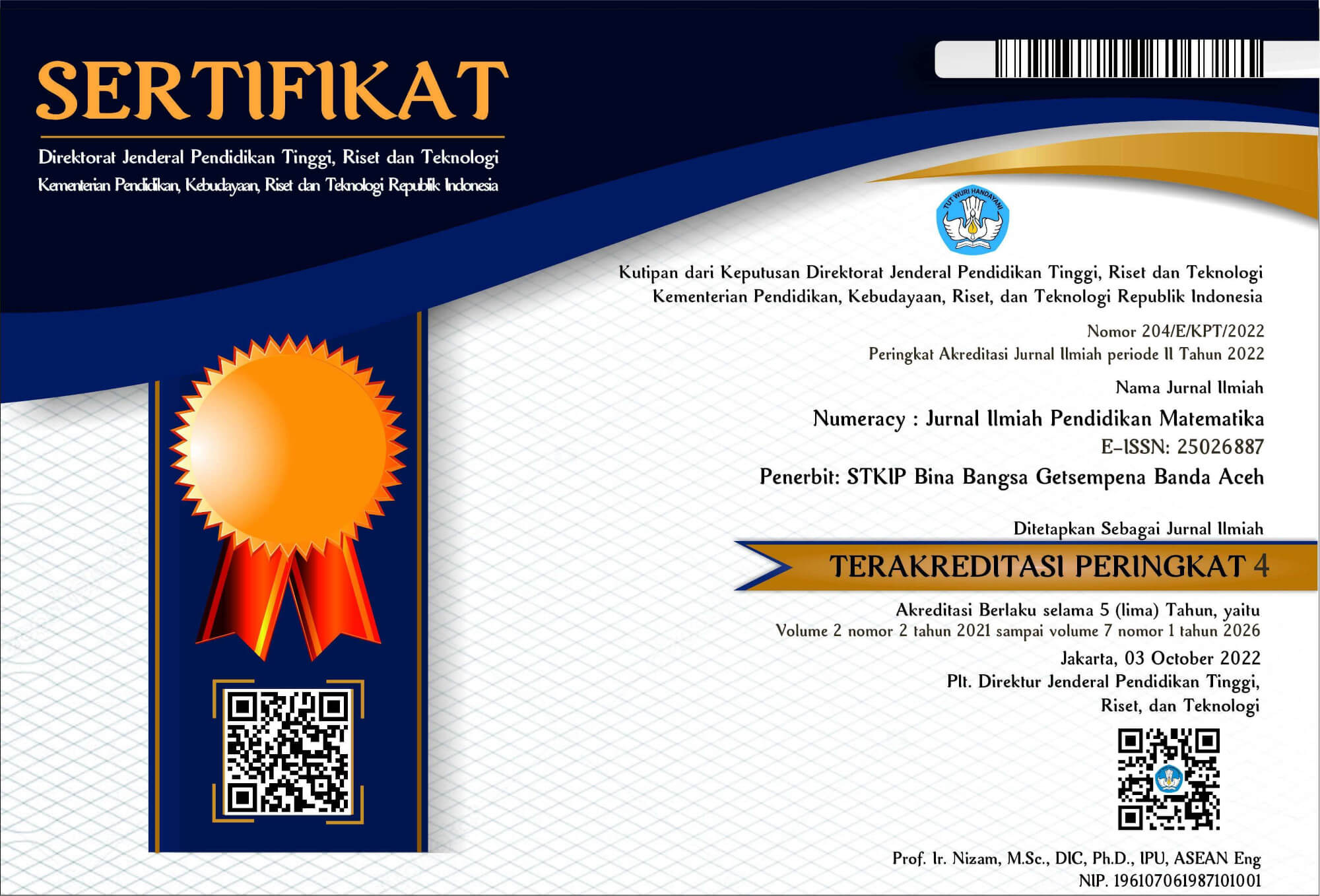
.png)

MOU

HIGH IMPACT PAPERS

INDEXED BY





PLAGIARISM CHECKER


VISITOR STATISTICS
|
Jl. Tanggul Krueng Lamnyong No.34, Rukoh |
Numeracy JournalTelp/Wa : +62 812 6982 0041 (Fitriati( |
 This work is licensed under a Creative Commons Attribution-NonCommercial 4.0 International License. |