SUBMISSION PREPARATION




All manuscripts submitted to Numeracy: Journal of Mathematics Education undergo a rigorous double-blind peer review process to ensure the quality, originality, and academic integrity of published articles. Each submission is initially evaluated by the editorial team to assess its alignment with the journal’s focus and scope, adherence to submission guidelines, and overall readiness for review. Manuscripts that pass this initial screening are then assigned to at least two independent reviewers with relevant expertise, who will evaluate the manuscript anonymously.
Reviewers are expected to assess manuscripts based on their scholarly merit, including originality, theoretical contribution, methodological rigor, and international relevance, particularly in relation to the journal’s emphasis on ethnomathematics and cultural dimensions, technology-enhanced mathematics learning, mathematics education in the Global South, mathematical thinking and learning processes, and interdisciplinary approaches in mathematics education. A strong manuscript should clearly identify a gap in the international literature, be grounded in an appropriate theoretical framework, and employ a sound and transparent research design. The data analysis must go beyond descriptive reporting and demonstrate depth and analytical rigor, while the discussion should critically engage with recent international studies and clearly articulate both theoretical and practical implications.
Reviewers should also evaluate whether the findings are generalizable or transferable beyond the local context and whether the manuscript contributes meaningfully to global academic discourse. Manuscripts that are purely descriptive, lack theoretical grounding, employ weak methodologies, or offer limited novelty and international relevance are unlikely to be recommended for publication. In addition, studies such as classroom action research or local case studies may be considered only if they demonstrate strong methodological rigor and provide broader implications.
Based on the reviewers’ reports, the editorial decision may fall into one of the following categories: acceptance, minor revision, major revision, or rejection. Authors are expected to revise their manuscripts in accordance with reviewers’ comments within the specified timeframe. Revised manuscripts may be returned to the reviewers for further evaluation when necessary. The final decision regarding publication rests with the editorial board.
Throughout the process, reviewers are expected to provide constructive, objective, and timely feedback, while maintaining confidentiality and adhering to ethical standards in peer review. This process is designed to ensure that Numeracy publishes high-quality research that is relevant, impactful, and aligned with international standards in mathematics education.
SUBMISSION PREPARATION
SINTA & ISSN CERTIFICATES
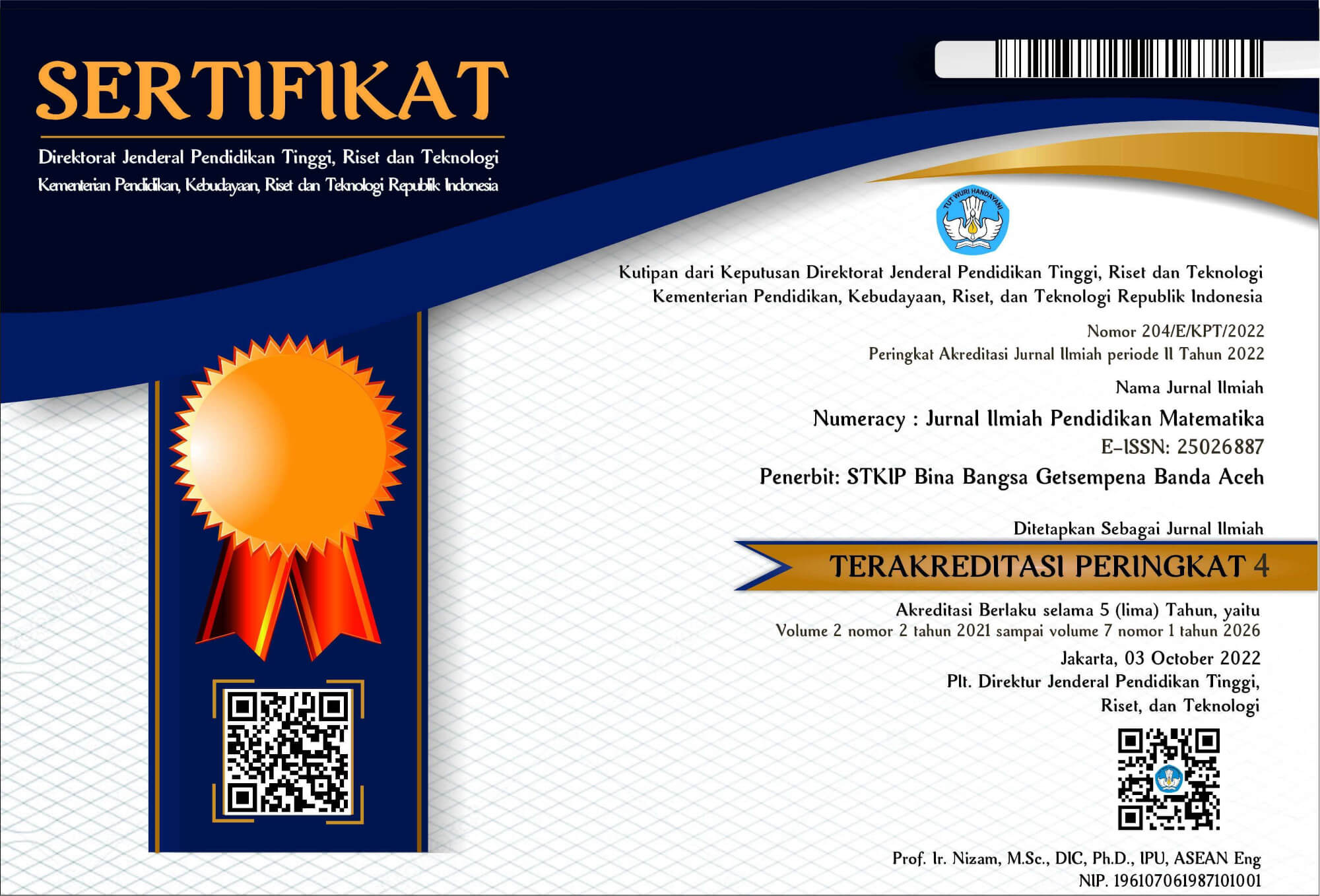
.png)

MOU

HIGH IMPACT PAPERS

INDEXED BY





PLAGIARISM CHECKER


VISITOR STATISTICS
|
Jl. Tanggul Krueng Lamnyong No.34, Rukoh |
Numeracy JournalTelp/Wa : +62 812 6982 0041 (Fitriati( |
 This work is licensed under a Creative Commons Attribution-NonCommercial 4.0 International License. |