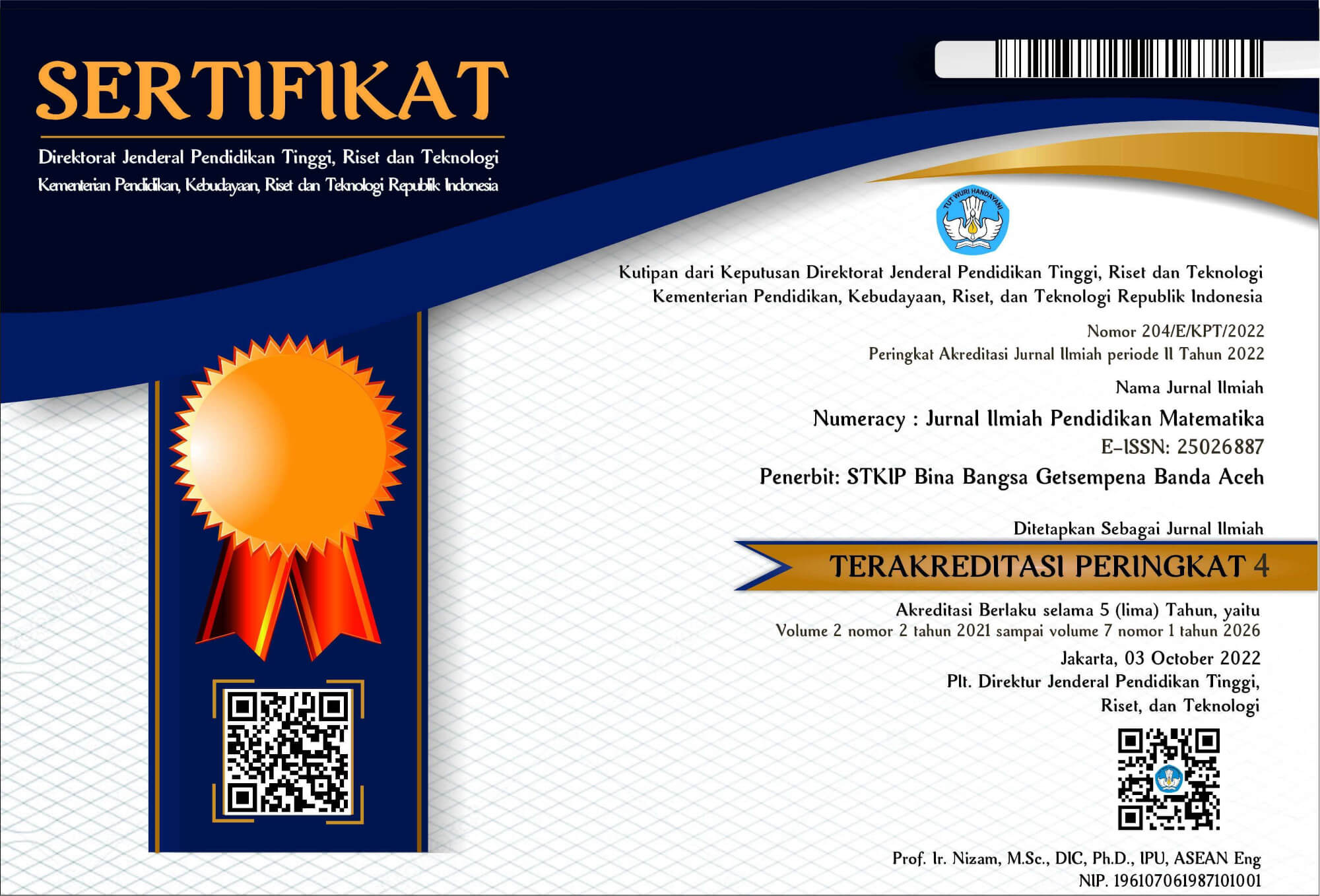
SINTA & ISSN CERTIFICATES
Focus and Scope
Numeracy Journal is an international, peer-reviewed journal that publishes high-quality research in mathematics education with a particular emphasis on cultural, technological, and Global South perspectives. The journal targets researchers, educators, and policymakers in mathematics education worldwide, particularly those interested in culturally responsive pedagogy, digital transformation, and educational development in diverse global contexts.
The journal aims to advance theoretical, empirical, and interdisciplinary scholarship that contributes to a deeper understanding of how mathematics is taught, learned, and contextualized across diverse socio-cultural settings. Finally, the journal welcomes original research articles, systematic reviews, and theoretical papers in the following areas:
- Ethnomathematics and Cultural Dimensions in Mathematics Education
This area explores the role of culture in shaping mathematical understanding and learning by examining how indigenous knowledge systems, local wisdom, and cultural practices can be meaningfully integrated into mathematics education. It includes studies on culturally responsive pedagogy, the use of ethnomathematical contexts to enhance student engagement, and comparative analyses of mathematics education across diverse cultural settings. The focus is on generating insights that not only preserve cultural heritage but also contribute to globally relevant mathematics teaching practices. - Technology-Enhanced Mathematics Learning
This area focuses on the integration of digital technologies to improve the quality and effectiveness of mathematics education. It covers the use of tools such as dynamic mathematics software, artificial intelligence, simulations, and interactive platforms in supporting conceptual understanding and student engagement. In addition, it includes research on online, blended, and mobile learning environments, as well as data-driven and adaptive learning systems that personalize instruction and provide evidence-based insights into student learning processes. - Mathematics Education in the Global South
This area emphasizes research on mathematics education within developing and underrepresented regions, particularly in the Global South, by addressing contextual challenges, innovative practices, and systemic issues. Topics include equity, access, and inclusion in mathematics learning, as well as policy analysis and curriculum development tailored to local needs. The aim is to produce knowledge that bridges local educational realities with global academic discourse, offering transferable insights and solutions for similar contexts worldwide. - Mathematical Thinking and Learning Processes
This area examines the cognitive and metacognitive processes involved in learning mathematics, including how students develop reasoning, problem-solving skills, and mathematical literacy. It also encompasses research on higher-order thinking skills, conceptual understanding, and the assessment methods used to evaluate these competencies. The goal is to deepen theoretical and empirical understanding of how learners think mathematically and how instruction can be designed to foster meaningful and sustained learning outcomes. - Interdisciplinary Approaches in Mathematics Education
This area highlights the integration of mathematics with other disciplines such as STEM, social sciences, and the humanities to promote contextual and meaningful learning. It includes studies on real-world applications of mathematics, problem-based and project-based learning, and the role of mathematics in addressing global issues such as sustainability. The focus is on developing interdisciplinary frameworks that enhance the relevance of mathematics education and prepare learners to apply mathematical knowledge in diverse and complex contexts.

.png)