SUBMISSION PREPARATION




Numeracy Journal is committed to upholding the highest standards of publication ethics and editorial integrity in accordance with internationally recognized guidelines, including those established by the Committee on Publication Ethics (COPE). The journal ensures that all stages of the publication process—from submission to final publication—are conducted transparently, fairly, and without undue influence from commercial or personal interests.
The editorial board is responsible for making publication decisions based solely on the scholarly merit of the submitted manuscripts, including their originality, academic rigor, clarity, and relevance to the journal’s focus and scope. Editorial decisions are independent and are not influenced by publication fees or any external funding sources. All submitted manuscripts undergo an initial editorial screening followed by a rigorous double-blind peer review process to ensure objectivity and quality.
Authors are required to submit original work that has not been published or submitted elsewhere. The journal strictly prohibits plagiarism, self-plagiarism, and redundant publication. All manuscripts are screened using plagiarism detection software, and submissions with a similarity index exceeding 20% will be rejected. Authors must properly acknowledge all sources and ensure that their work is free from unethical practices such as data fabrication, falsification, or inappropriate authorship. Submitting the same manuscript to multiple journals simultaneously is considered unethical and unacceptable.
Reviewers play a critical role in maintaining the quality of the journal by providing objective, constructive, and timely evaluations of submitted manuscripts. They are expected to maintain confidentiality, avoid conflicts of interest, and evaluate manuscripts based on academic merit, methodological rigor, and international relevance. Reviewers should identify ethical concerns, including potential plagiarism or data issues, and provide recommendations that support the integrity of the publication process.
Editors are responsible for ensuring a fair and unbiased review process, maintaining confidentiality, and addressing any ethical concerns that may arise during the review or after publication. In cases of suspected misconduct, including plagiarism, duplicate publication, or ethical violations, the editorial board will take appropriate actions, which may include rejection, retraction, or notification to relevant institutions.
As an open access journal, Numeracy provides free and unrestricted access to all published articles, allowing readers to read, download, and distribute content without financial barriers, while authors may be required to pay a publication fee to support the editorial and dissemination process. The journal operates under a Creative Commons license, enabling the dissemination of knowledge while ensuring proper attribution to the original authors.
The journal is committed to maintaining the integrity of the scholarly record. Corrections, clarifications, retractions, and apologies will be published when necessary to address errors or ethical concerns. All parties involved in the publication process—authors, editors, reviewers, and publishers—are expected to adhere to these ethical standards to ensure the credibility and academic value of the journal.
SUBMISSION PREPARATION
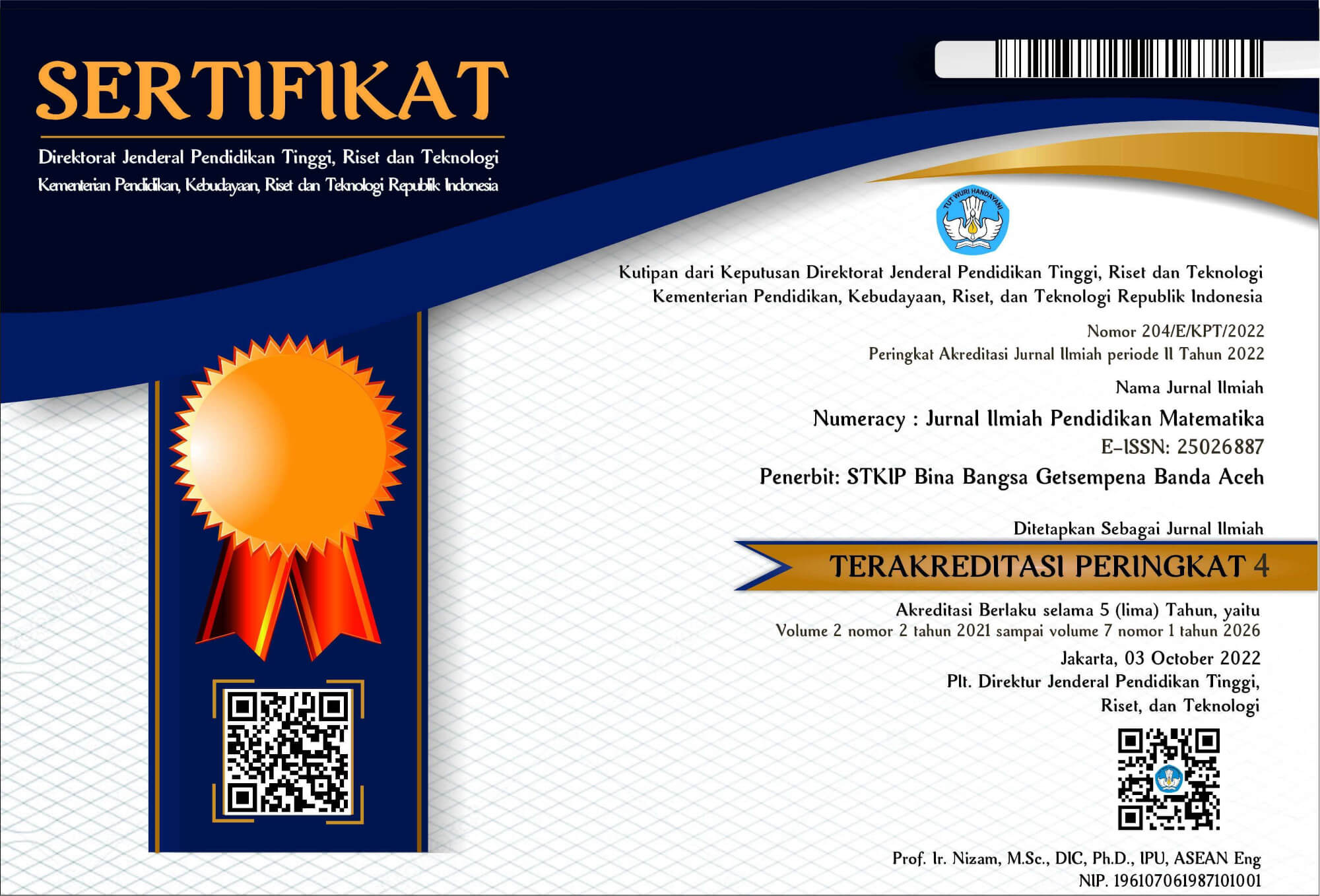
SINTA & ISSN CERTIFICATES
.png)

MOU

HIGH IMPACT PAPERS

INDEXED BY





PLAGIARISM CHECKER


VISITOR STATISTICS
|
Jl. Tanggul Krueng Lamnyong No.34, Rukoh |
Numeracy JournalTelp/Wa : +62 812 6982 0041 (Fitriati( |
 This work is licensed under a Creative Commons Attribution-NonCommercial 4.0 International License. |